


The Immediate Case for Universal Basic Income (UBI)

Why We Can't Wait: AI, Jobs, and the Safety Net We Need Now
Hey everyone, this week, Amazon just announced over 16,000 job cuts. As someone who's been diving deep into AI and its real-world applications, I've witnessed firsthand how these technologies are fundamentally reshaping entire industries. Through my work and research in supply chain optimization, I'm acutely aware that AI isn't just coming for our jobs—it's already here, quietly automating tasks from predictive analytics to warehouse management.
The data is sobering: McKinsey reports show AI can slash logistics costs by 5-20%, but this efficiency comes at a price measured in displaced workers. The World Economic Forum projects 92 million jobs lost globally by 2030, with 170 million created—leaving potentially millions behind, especially in sectors where cognitive work dominates.
Today, I want to make the immediate case for Universal Basic Income (UBI) as the crucial safety net we need—not in some distant future, but right now. Let's break it down with the latest research, reports, and hard truths.
The AI Displacement Wave Has Arrived
This isn't speculation anymore—we're living through it in early 2026. Industry leaders are sounding alarms that we can no longer ignore:
- Anthropic CEO Dario Amodei recently described AI's labor market impact as "unusually painful," warning it will function as a general substitute for human workers across sectors.
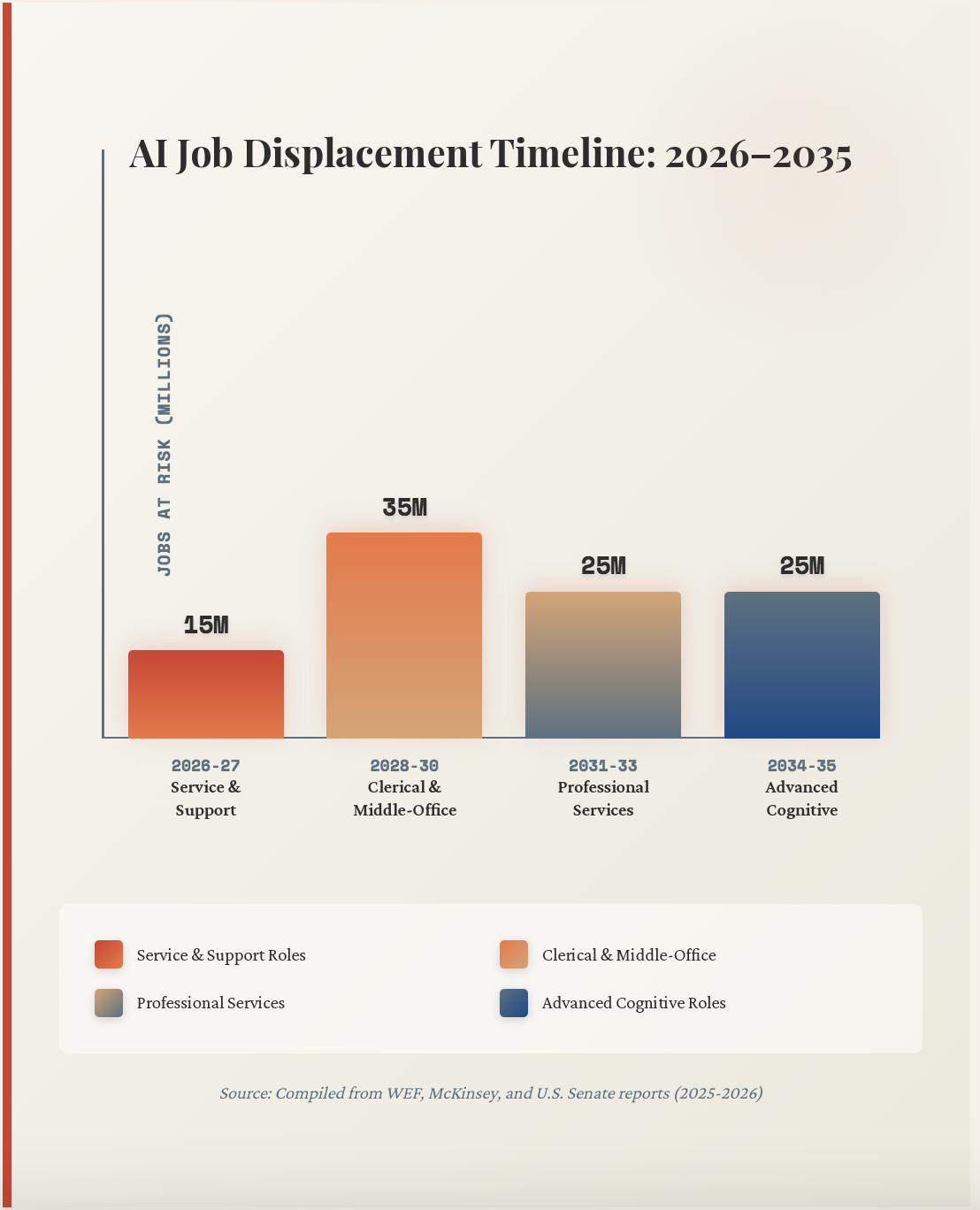
- A U.S. Senate report estimates AI could eliminate up to 100 million American jobs within the next decade—nearly one-third of the workforce.
- UK Investment Minister Jason Stockwood has proposed UBI as a way to "soft-land" industries facing AI disruption, coupling it with lifelong learning initiatives.
The timeline is accelerating faster than anyone predicted. Here's what the experts are mapping out:
McKinsey's research suggests that up to 45% of U.S. jobs could be automated within the next two decades, with transportation, customer service, and supply chain roles facing the highest exposure. Meanwhile, Morgan Stanley data shows the UK is already experiencing net job losses to AI—and similar patterns are emerging stateside.
As we start Black History Month, it's crucial to acknowledge that these disruptions won't affect all communities equally. Black workers are disproportionately concentrated in administrative, service, and transportation roles—precisely the sectors facing the highest automation risk. Without proactive intervention like UBI, AI threatens to widen existing racial wealth gaps rather than close them.
Supply Chains: Ground Zero for AI Disruption
From my perspective working in this space, supply chains represent the frontline of AI transformation. I've tracked how my company, Journey AI, and other's AI agents are revolutionizing procurement and operations, with structured tasks like demand forecasting and route optimization leading the charge. But this transformation has a darker side that we need to confront honestly.
The Numbers Don't Lie
According to the Equitable Growth report:
- Over 200,000 logistics managers face more than 90% of their tasks being automatable—signaling extremely high displacement risk
- Manual roles like truck mechanics show almost zero automation susceptibility, highlighting the uneven distribution of AI's impact
- White-collar supply chain positions are experiencing job growth slowdowns while AI capabilities expand
J.P. Morgan's research reveals rising unemployment among college-educated workers in AI-exposed fields. Meanwhile, MIT studies add crucial nuance: when AI handles most tasks in a specific role, employment drops by 14%. However, partial automation can actually increase jobs by allowing workers to focus on higher-value activities.
The challenge? This shift demands massive reskilling—something not everyone can access without financial support. The World Economic Forum's executive survey shows 54% expect net job displacement from AI, while only 24% predict net creation. Without proactive intervention, inequality will accelerate dramatically.
Why UBI? The Economic and Social Imperative
Universal Basic Income isn't welfare—it's an economic stabilizer for the AI age.
UBI provides unconditional cash payments to all adults, ensuring basic needs are met regardless of employment status. Recent trials demonstrate that recipients don't stop working, and the program could save billions in administrative overhead compared to traditional welfare systems.
The Case for UBI Right Now
- Economic buffer: UBI counters wage suppression and provides a foundation for workers to retrain, pursue education, or explore entrepreneurial ventures without the constant threat of financial ruin.
- Unprecedented speed: Unlike previous technological revolutions that unfolded over decades, AI is transforming entire sectors within years. We simply don't have time for slow, reactive policies.
- Wealth redistribution: OpenAI's Sam Altman and others have proposed funding UBI (or "Universal High Income") through taxes on AI-generated profits, ensuring productivity gains benefit everyone, not just tech shareholders.
- Social stability: JPMorgan Chase CEO Jamie Dimon has warned of potential civil unrest without intervention. Mass unemployment without safety nets is a recipe for societal breakdown.
Addressing the Critics
Critics claim UBI discourages work, but historical evidence shows that technological innovation creates economic growth, not permanent job loss—at least eventually. The difference with AI is the
speed. Previous transitions gave workers and institutions time to adapt. AI doesn't afford us that luxury.
Funding UBI: How We Make It Work
The question isn't whether we can afford UBI—it's whether we can afford not to implement it. Several funding mechanisms are being seriously discussed:
- AI profit taxes: Windfall taxes on tech giants whose AI systems are replacing human workers, redistributing productivity gains back to society.
- Labor cost savings tax: A sales tax mechanism that captures a portion of the labor costs companies save through automation.
- Administrative efficiency: Eliminating the complex bureaucracy of means-tested programs could save billions while delivering more direct support to those who need it.
The economics are straightforward: if AI is creating unprecedented productivity gains, those benefits should flow to everyone, not accumulate at the top. UBI is how we make that happen.
We Can't Wait for the 2030s
The future is already here—it's just not evenly distributed yet. With AI systems like xAI's Grok and next-generation models advancing at breakneck speed, we're looking at a fundamental restructuring of our economy within years, not decades.
We must act now to:
- Launch pilot UBI programs in AI-exposed regions and industries
- Invest massively in accessible reskilling and lifelong learning infrastructure
- Rethink our economic models to account for a world where traditional employment may not be the primary income source for millions
As someone tracking AI's transformation of supply chains and beyond, I believe UBI is the essential bridge to a future where technology serves everyone, not just a privileged few. The abundance AI promises is real—but only if we have the courage to build systems that share it equitably.
What do you think? Is UBI the answer, or are there better alternatives? Share your thoughts in the comments—let's discuss how we can build a more equitable AI era together.
Stay curious,
Riana
@rianalynn